Quick answer
Oral probiotics produce a small, statistically measurable improvement in gum bleeding and plaque when used alongside brushing, flossing, and professional cleaning. The effect is modest, the studies are mostly low-grade, and the benefit reverts roughly four weeks after stopping. Probiotics are studied as adjuncts to professional care, never as replacements, and they do not cure gum disease.
- Oral probiotics offer a small adjunct benefit for plaque and gum bleeding
- Benefits revert roughly four weeks after stopping the probiotic
- No probiotic replaces brushing, flossing, or professional dental cleaning
Short on time? Our pick
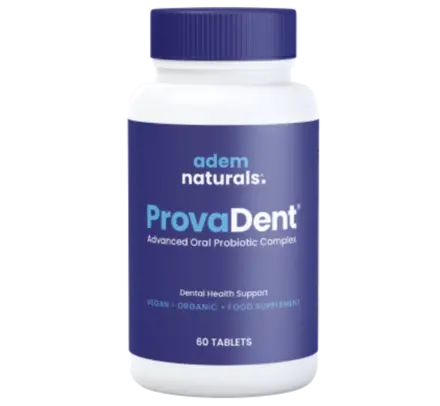
ProvaDent
Oral probiotic support
Our editorial score.Scored on formulation, refund policy, and value, not on a proven cure. No gum-disease supplement is clinically proven.
The oral-health supplement we'd try first, if we were going to try one.
- 60-day money-back guarantee, which covers the trial period if it does not help
- Sold through BuyGoods, which processes refunds reliably
- Aimed at the oral microbiome, the current focus of gum-health research
No supplement is proven to cure gum disease or regrow bone. We highlight ProvaDent for its formulation and guarantee, not as a cure.
Do oral probiotics work for gum health? The honest answer is yes, a little, and only as an add-on. The research shows a real but modest benefit for gum bleeding and plaque when probiotics are taken alongside good hygiene and professional cleaning. The effect is small, the studies are mostly low-grade, and it tends to fade once you stop. That is a more useful answer than either the cure-in-a-bottle pitch or a flat dismissal.
The short answer
Oral probiotics produce a small, statistically measurable improvement in gum bleeding and plaque when used as an adjunct to brushing, flossing, and professional cleaning. A meta-analysis of oral probiotics found a significant but small effect on plaque and bleeding on probing, while noting that the clinical relevance is uncertain. They do not replace mechanical cleaning, they do not cure gum disease, and the benefit reverts after you stop. So they can be a reasonable add-on for some people, with realistic expectations.
What the trials actually found
The evidence here is better than for many supplement categories, which is exactly why it deserves an honest reading rather than hype.
A systematic review of probiotics added to scaling and root planing found a modest improvement, with pocket depth reduced by roughly 0.40 to 0.61 mm and a small clinical attachment gain at three months, per this PubMed-indexed review. On the gingivitis side, a foundational randomized trial showed that Lactobacillus reuteri reduced gum bleeding versus placebo. And the broader meta-analysis put numbers on it: a plaque-index effect with a 95% confidence interval around -0.54 to -0.15 and a bleeding-on-probing effect around -0.58 to -0.05, while pocket depth did not reach significance.
Read those numbers carefully. A sub-millimeter change in pocket depth is real but small, and a confidence interval that creeps close to zero on bleeding signals an effect that is present but not dramatic. This is a modest, low-grade benefit, not a transformation.
Why “modest” and “low-grade” are the right words
Three things keep this evidence from being stronger than it is.
- The studies are mostly small and biased. Many are short, with modest participant numbers and varied designs, which lowers the certainty of the pooled result.
- The effect is small in absolute terms. Sub-millimeter pocket changes and small bleeding reductions matter at the population level but may be hard to notice as an individual.
- It reverts. The introduced bacteria do not permanently colonize your mouth, so the benefit tends to fade roughly four weeks after you stop taking the product.
That last point is the one marketing pages never mention. If the improvement depends on continued use, the product is a maintenance cost, not a one-time fix.
What probiotics can and cannot do for your gums
| Question | Honest answer |
|---|---|
| Reduce gum bleeding as an add-on? | Yes, modestly, in studies. |
| Reduce plaque as an add-on? | Yes, a small effect. |
| Meaningfully reverse deep pockets? | Not reliably; pocket-depth effects are small and inconsistent. |
| Replace brushing, flossing, and cleaning? | No. Always studied as an addition, never a replacement. |
| Cure gum disease or regrow tissue? | No. Periodontal bone loss is not reversed by a pill. |
| Last after you stop? | No. Benefit tends to revert about four weeks later. |
The pattern is consistent: a small adjunct benefit on the softer measures, nothing on cure or replacement.
How to think about trying one
If you decide to try an oral probiotic, frame it correctly. It is an add-on to a routine that does the real work: brushing, flossing, and professional cleaning. The ADA frames nutrition and oral health as a support to good hygiene, not a substitute, and the NIDCR is clear that gum disease is managed through professional care. A probiotic might add a small bonus on top of that. It will not carry the load by itself.
Two practical notes. First, because any benefit reverts after stopping, expect that you would need to keep taking it to keep the effect, so weigh the ongoing cost. Second, no branded oral probiotic product has an independent trial of the finished formula, so you are buying based on strain research, not product proof. A money-back guarantee is what makes a trial low-risk under those conditions.
Bottom line
Oral probiotics work for gum health in a narrow, honest sense: a modest, low-grade improvement in gum bleeding and plaque when added to good hygiene, with little reliable effect on deep pockets and no effect that survives stopping. They are an add-on, not a treatment, and certainly not a cure. If your gums bleed or hurt, the highest-value move is still a dental visit and a solid daily routine. A probiotic can sit on top of that as a small, bounded experiment, best tried with a guarantee so the only thing at risk is a little of your time.
Related notes
The bottom line
No supplement is proven to cure gum disease or regrow bone. We highlight ProvaDent for its formulation and guarantee, not as a cure. If you decide to try one, ProvaDent is the option we would pick, mainly because the 60-day money-back guarantee makes a trial risk-free.
Check Latest Price for ProvaDentFrequently asked questions
Do oral probiotics actually work for gum health?
Modestly, and only as an add-on. Systematic reviews show oral probiotics produce a small but statistically significant reduction in gum bleeding and plaque when added to professional cleaning, with one meta-analysis reporting a bleeding-on-probing effect in the range of -0.58 to -0.05. The effect on pocket depth is smaller and not always significant, the studies are mostly low-grade, and the benefit tends to revert about four weeks after you stop. So probiotics can help a little alongside good hygiene, but they are not a standalone fix.
Are oral probiotics a replacement for brushing and flossing?
No. Every credible study tests probiotics as an addition to scaling, brushing, and flossing, not as a substitute for them. The plaque and bacteria that drive gum disease are removed mechanically by brushing, flossing, and professional cleaning, and a probiotic does not replace that mechanical removal. Think of an oral probiotic as a possible small bonus on top of a solid routine, never as permission to skip the routine.
How long do oral probiotic benefits last?
Not long after you stop. Research suggests the gum-health benefits of oral probiotics tend to fade roughly four weeks after discontinuation, because the introduced bacteria do not permanently colonize the mouth. This is an important honesty point: any improvement is likely to be maintenance-dependent, meaning you would need to keep taking the product to keep whatever modest effect it provides. That ongoing cost is worth factoring into your decision.
Which probiotic strains have the best evidence for gums?
Lactobacillus reuteri has the most studied signal as an adjunct in gingivitis and periodontitis, with a foundational randomized trial showing reduced gum bleeding versus placebo and later reviews showing modest pocket-depth improvements when added to scaling. BLIS K-12 has small-trial signal mainly for bad breath rather than gum disease. Even for the better-studied strains, the evidence is modest and low-grade, and no finished branded product has its own independent trial.
Sources & references
Every claim above is drawn from these primary sources.
- ● Oral probiotics and periodontal parameters - meta-analysis · PMC (National Library of Medicine)
- ● Probiotics as an adjunct to scaling and root planing - systematic review · PubMed (National Library of Medicine)
- ● Lactobacillus reuteri reduces gingival bleeding - randomized trial · PubMed (National Library of Medicine)
- ● Gum Disease (Periodontal Disease) · NIDCR (National Institutes of Health)
- ● Nutrition and Oral Health · American Dental Association
Free checklist
The 12 checks to run on a gum supplement label before you pay for it.
A one-page checklist drawn from ADA, Cochrane Oral Health and NIH/NIDCR guidance, plus the FTC's own rules on supplement advertising. It tells you which label claims mean something, which are decoration, and the wording that signals a product is not worth your money. We send it immediately, then one short note a week.
One click to unsubscribe. We never sell or share your address. Privacy.